






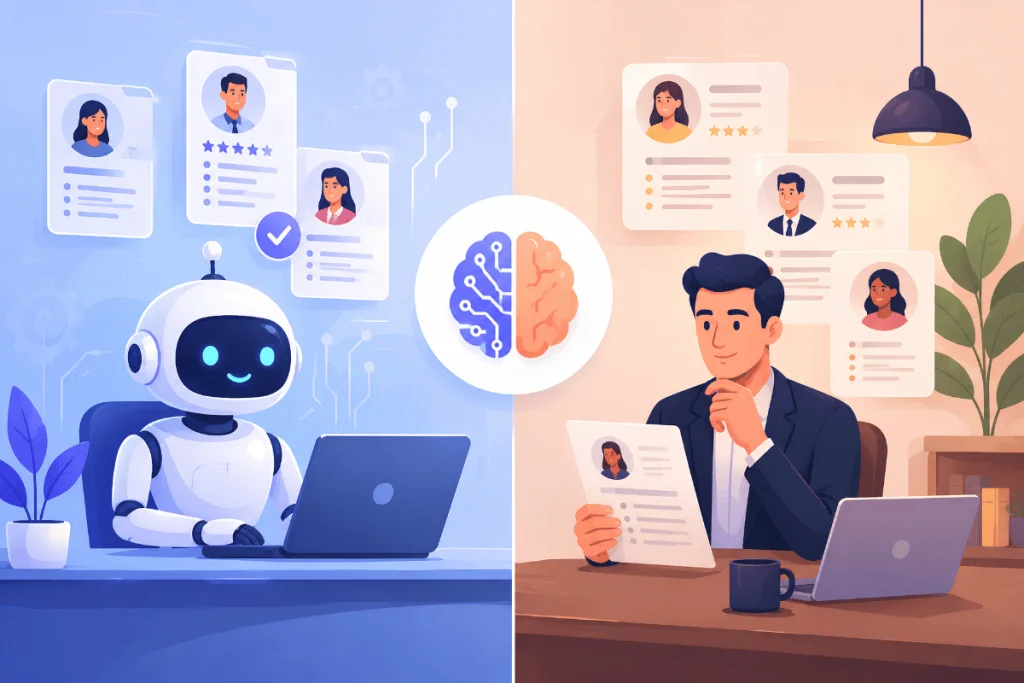

Recruitment has changed dramatically over the past decade. Businesses today face increasing pressure to hire qualified talent quickly while maintaining a positive candidate experience and controlling recruitment costs.
To meet these demands, many organizations have adopted artificial intelligence (AI) tools and AI-powered platforms that automate candidate screening, scheduling, and talent matching. At the same time, human recruiters continue to play a critical role in evaluating soft skills, cultural fit, and long-term potential.
This raises an important question:
Is AI more efficient than human recruiters?
The answer is not as simple as choosing one over the other. Both AI and human recruiters offer unique advantages, and the most successful organizations are learning how to combine them effectively.
This guide explores AI vs human recruitment efficiency, compares their strengths and limitations, and explains how businesses can build smarter hiring strategies in 2026.
What Is Recruitment Efficiency?
Recruitment efficiency refers to how effectively a company attracts, evaluates, and hires qualified candidates while minimizing time, costs, and resources.
Common recruitment metrics include:
- Time-to-hire
- Cost-per-hire
- Quality of hire
- Candidate satisfaction
- Offer acceptance rate
An efficient recruitment process helps businesses fill positions faster without sacrificing candidate quality.
Why Recruitment Efficiency Matters
Hiring delays can significantly impact business performance.
When positions remain unfilled:
- Productivity decreases
- Existing employees face heavier workloads
- Revenue opportunities may be lost
- Project timelines can suffer
Efficient hiring processes allow organizations to secure top talent before competitors do.
As talent shortages continue across many industries, recruitment efficiency has become a major competitive advantage.
How AI Improves Recruitment Efficiency
Artificial intelligence is transforming recruitment by automating repetitive tasks and analyzing large volumes of candidate data.
Instead of manually reviewing hundreds of applications, recruiters can use AI to identify the most qualified candidates in minutes.
Key Ways AI Improves Recruitment
Automated Resume Screening
AI systems can quickly analyze resumes based on predefined criteria.
Benefits include:
- Faster candidate evaluation
- Reduced manual workload
- Consistent screening processes
Candidate Matching
AI algorithms compare candidate skills and experience against job requirements.
This helps recruiters identify strong matches more efficiently.
Interview Scheduling
Scheduling interviews often involves multiple emails and calendar coordination.
AI-powered tools automate scheduling, saving valuable time.
Recruitment Analytics
AI can analyze hiring data to identify patterns and improve future recruitment strategies.
Organizations gain insights into:
- Hiring trends
- Candidate behavior
- Recruitment performance
Faster Communication
AI chatbots can answer candidate questions, provide updates, and maintain engagement throughout the hiring process.
Strengths of Human Recruiters
Despite advances in AI, human recruiters remain essential.
Recruitment is not purely about skills and qualifications.
It also involves understanding people.
Human Strengths in Recruitment
Emotional Intelligence
Recruiters can evaluate:
- Personality
- Communication style
- Motivation
- Interpersonal skills
These qualities are difficult for AI to assess accurately.
Cultural Fit Evaluation
Hiring success often depends on how well candidates fit within an organization’s culture.
Human recruiters are better equipped to evaluate this factor.
Relationship Building
Strong candidate relationships improve employer branding and hiring outcomes.
Human interactions build trust more effectively than automated systems.
Complex Decision-Making
Recruitment often involves nuances that cannot be fully captured through data alone.
Human judgment remains critical when making final hiring decisions.
AI vs Human Recruitment: Side-by-Side Comparison
| Factor | AI Recruitment | Human Recruitment |
| Speed | Extremely fast | Slower |
| Resume Screening | Highly efficient | Time-consuming |
| Candidate Experience | Fast responses | More personalized |
| Emotional Intelligence | Limited | Strong |
| Bias Reduction | Depends on data quality | Depends on recruiter awareness |
| Cost Efficiency | Lower operational costs | Higher labor costs |
| Cultural Fit Assessment | Limited | Excellent |
| Relationship Building | Minimal | Strong |
| Scalability | High | Moderate |
| Final Hiring Decisions | Data-driven | Context-driven |
Where AI Outperforms Human Recruiters
AI excels in high-volume recruitment environments.
Examples include:
- Customer service hiring
- Retail recruitment
- Entry-level positions
- Large-scale hiring campaigns
Why AI Works Well
AI can process thousands of applications simultaneously. This capability is one reason why startups hire using AI, as it helps them quickly identify qualified candidates, automate screening tasks, and reduce recruitment costs while competing for talent with larger organizations.
This dramatically reduces:
- Screening time
- Administrative workload
- Recruitment costs
Organizations often see significant improvements in time-to-hire after implementing AI tools.
Where Human Recruiters Perform Better
Certain hiring situations require deeper evaluation.
Examples include:
- Executive recruitment
- Leadership positions
- Specialized technical roles
- Client-facing positions
Why Human Recruiters Excel
These roles often require:
- Leadership assessment
- Strategic thinking evaluation
- Relationship-building capabilities
- Cultural alignment
Human judgment remains indispensable in these situations.
The Best Approach: AI and Human Collaboration
Many organizations mistakenly view AI and human recruiters as competing solutions.
In reality, the most effective hiring strategies combine both.
How Hybrid Recruitment Works
AI handles:
- Resume screening
- Candidate sourcing
- Scheduling
- Analytics
Human recruiters focus on:
- Interviews
- Relationship building
- Final evaluations
- Offer negotiations
This combination maximizes efficiency while preserving the human element of recruitment.
Challenges of AI Recruitment
While AI offers significant benefits, it is not without limitations.
Data Bias
AI systems learn from historical data.
If training data contains bias, AI may unintentionally replicate it.
Limited Context Understanding
AI struggles with nuanced situations and unconventional career paths.
Some exceptional candidates may be overlooked.
Candidate Concerns
Many candidates still prefer interacting with people rather than automated systems.
Balancing automation with personalization is essential.
Challenges of Human Recruitment
Traditional recruitment also has limitations.
Time-Consuming Processes
Manual screening and coordination require significant effort.
Higher Costs
Recruiter salaries, agency fees, and administrative expenses can increase hiring costs.
Human Bias
Even experienced recruiters can have unconscious biases that influence hiring decisions.
How AI Is Reshaping Recruitment in 2026
The recruitment industry continues to evolve rapidly.
Emerging trends include:
- Predictive hiring analytics
- AI-powered talent matching
- Automated candidate engagement
- Skills-based hiring models
- Intelligent workforce planning
Organizations that embrace these innovations are often able to hire faster and more effectively by leveraging the 10 best AI recruitment tools for candidate sourcing, screening, scheduling, and talent matching.
How Modern Platforms Support Recruitment Efficiency
Recruitment efficiency depends not only on finding candidates but also on managing opportunities, communication, and workflows effectively.
Platforms like Ojiiz help businesses organize opportunities, streamline communication, and improve workflow visibility. By centralizing these activities and offering flexible pricing & plans, organizations can reduce manual processes, maintain better operational oversight, and support more efficient hiring and business development efforts.
Future of Recruitment: Humans and AI Working Together
The future of hiring is unlikely to be fully automated.
Instead, recruitment is moving toward a collaborative model where AI enhances human decision-making.
Organizations that combine:
- AI efficiency
- Human expertise
- Data-driven insights
- Personalized candidate experiences
will achieve the best hiring outcomes.
Businesses that adopt this balanced approach will remain more competitive in increasingly complex talent markets.
Conclusion
The debate between AI vs human recruitment efficiency is not about choosing one over the other.
AI offers speed, scalability, and automation, while human recruiters provide emotional intelligence, relationship-building skills, and contextual decision-making.
The most successful organizations use AI to handle repetitive tasks and empower recruiters to focus on higher-value activities.
As hiring becomes increasingly competitive in 2026, businesses that combine technology with human expertise will attract better talent, improve recruitment outcomes, and build stronger teams.
Frequently Asked Questions (FAQs)
1. Is AI more efficient than human recruiters?
AI is generally faster at screening candidates and managing repetitive tasks, while human recruiters are better at assessing soft skills and cultural fit.
2. Can AI replace recruiters?
No. AI can automate many recruitment activities, but human judgment remains essential for interviews, relationship building, and final hiring decisions.
3. What are the biggest benefits of AI recruitment?
AI improves speed, reduces hiring costs, automates administrative work, and enhances candidate matching.
4. What are the limitations of AI in recruitment?
AI may struggle with contextual decision-making, cultural fit evaluation, and complex human interactions.
5. What is a hybrid recruitment model?
A hybrid model combines AI automation with human expertise to improve efficiency while maintaining quality hiring decisions.
6. How does Ojiiz support recruitment efficiency?
Ojiiz helps businesses organize opportunities, manage communications, and improve workflow visibility to support more efficient recruitment processes.
7. Can Ojiiz help teams manage hiring-related workflows?
Yes. Ojiiz provides a centralized platform where teams can track opportunities, streamline communication, and maintain organized workflows.
8. What is the future of recruitment in 2026?
The future of recruitment will focus on AI-human collaboration, predictive analytics, skills-based hiring, and more personalized candidate experiences.