








Introduction
Most articles talk about AI. Businesses want to know what AI actually does, where it fits, and how it improves results without wasting budget or trust.
AI platforms are now used because modern lead generation produces too much data for humans alone:
- Thousands of visits
- Multiple touchpoints
- Long decision cycles
- Hidden buying signals
AI exists to filter noise, identify intent, and guide action. This article explains how that happens in real marketing systems, based on current industry practices, data science principles, and widely adopted enterprise workflows.
What an AI Lead Generation Platform Really Is
An AI lead generation platform is a system that uses machine learning models to analyze prospect behavior and predict conversion likelihood.
It does not replace marketing or sales. It:
- Processes large volumes of behavioral data
- Identifies statistically significant patterns
- Continuously updates predictions based on outcomes
Most platforms combine:
- Data ingestion layer
- Machine learning models
- Automation engine
- CRM and analytics integration
If you want a system-level explanation of how these platforms operate end-to-end, this resource explains it clearly: What is a Lead Generation Platform
How AI Collects and Uses Lead Data
AI platforms work only as well as the data they receive. Modern systems rely on first-party data and verified sources.
Primary Data Sources
- Website behavior (pages, scroll depth, return visits)
- Email interactions (opens, clicks, replies)
- CRM history (past deals, lifecycle stages)
- Ad engagement
- Form and chat submissions
AI models transform this raw data into feature sets, measurable indicators used to predict intent.
How AI Lead Scoring Actually Works
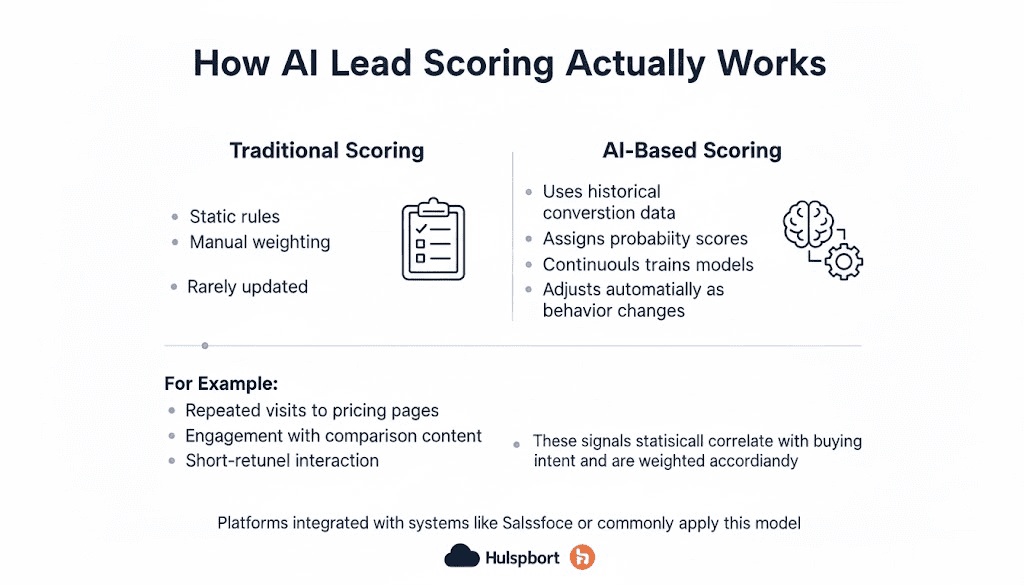
Lead scoring is one of the most misunderstood areas of AI.
Traditional Scoring
- Static rules
- Manual weighting
- Rarely updated
AI-Based Scoring
- Uses historical conversion data
- Assigns probability scores
- Continuously trains models
- Adjusts automatically as behavior changes
For example:
- Repeated visits to pricing pages
- Engagement with comparison content
- Short return intervals
- Multi-channel interaction
These signals statistically correlate with buying intent and are weighted accordingly.
Platforms integrated with systems like Salesforce or HubSpot commonly apply this model.
Using AI for Lead Segmentation
Segmentation is where AI becomes operationally valuable.
Instead of broad segments like “industry” or “company size,” AI creates clusters based on:
- Behavioral similarity
- Engagement velocity
- Funnel position
- Content consumption patterns
This allows marketers to:
- Send fewer but more relevant messages
- Avoid over-nurturing cold leads
- Align messaging with the intent stage
AI in B2B Lead Generation: Practical Use Cases
B2B buying decisions involve multiple stakeholders and long evaluation periods. AI helps manage this complexity.
Account-Level Intelligence
AI platforms track engagement across multiple contacts within one organization and aggregate intent signals at the account level.
Buying Committee Detection
By analyzing role-based behavior, AI can identify decision-makers vs. influencers.
Pipeline Prioritization
Sales teams receive ranked accounts based on readiness, not just activity volume.
A detailed, step-by-step explanation of B2B execution is covered here: How to Generate B2B Leads Successfully
How AI Automates Lead Engagement (Without Losing Control)
Automation does not mean loss of oversight.
AI platforms typically automate:
- Email sequencing triggers
- Chat responses for common queries
- Lead routing to sales teams
- Ad retargeting based on behavior
Human teams still:
- Approve messaging
- Set engagement rules
- Monitor model performance
- Handle high-value conversations
This balance ensures compliance, accuracy, and brand consistency.
Evaluating AI Lead Generation Platforms
Choosing an AI platform should be evidence-based.
What to Ask Vendors
- What data is used to train models?
- How often are models retrained?
- Can lead scoring logic be reviewed?
- How is data privacy handled?
- What integrations are native?
A current comparison of tools and capabilities is available here: Best Platforms for Lead Generation
Data Privacy, Compliance, and Trust
AI systems must operate within strict ethical and legal boundaries.
Reliable platforms:
- Use consent-driven data
- Support GDPR and regional regulations
- Offer audit logs
- Allow manual overrides
Trust directly affects lead quality. Users who understand data usage are more likely to engage honestly.
Measuring Real Performance
AI metrics should connect directly to revenue.
Key indicators:
- Lead-to-opportunity ratio
- Sales-qualified lead accuracy
- Cost per opportunity
- Conversion time reduction
Validation through tools like Google Analytics ensures performance claims are grounded in real data.
How AI Supports Search and Content Strategy
AI platforms analyze search intent and content performance, but do not replace expertise.
Effective teams use AI to:
- Identify information gaps
- Improve content relevance
- Align topics with buyer stages
- Reduce bounce rates
Human-written content remains essential for trust, clarity, and long-term visibility.
Frequently Asked Questions (FAQs)
Does AI require large datasets to work?
AI performs better with more data, but many platforms work effectively with moderate volumes using pre-trained models.
Is AI lead generation suitable for regulated industries?
Yes, if platforms follow compliance standards and allow human oversight.
Can AI misclassify leads?
Yes. Regular monitoring and feedback loops are required to maintain accuracy.
How long does model training take?
Initial models may work immediately, but optimization improves over weeks or months.
Conclusion
AI lead generation works when it is understood, monitored, and aligned with real business goals.
It improves focus, reduces wasted effort, and helps teams respond to real intent, not assumptions. Businesses that treat AI as a decision-support system, rather than a shortcut, gain measurable, sustainable growth built on trust and data-driven insight.