






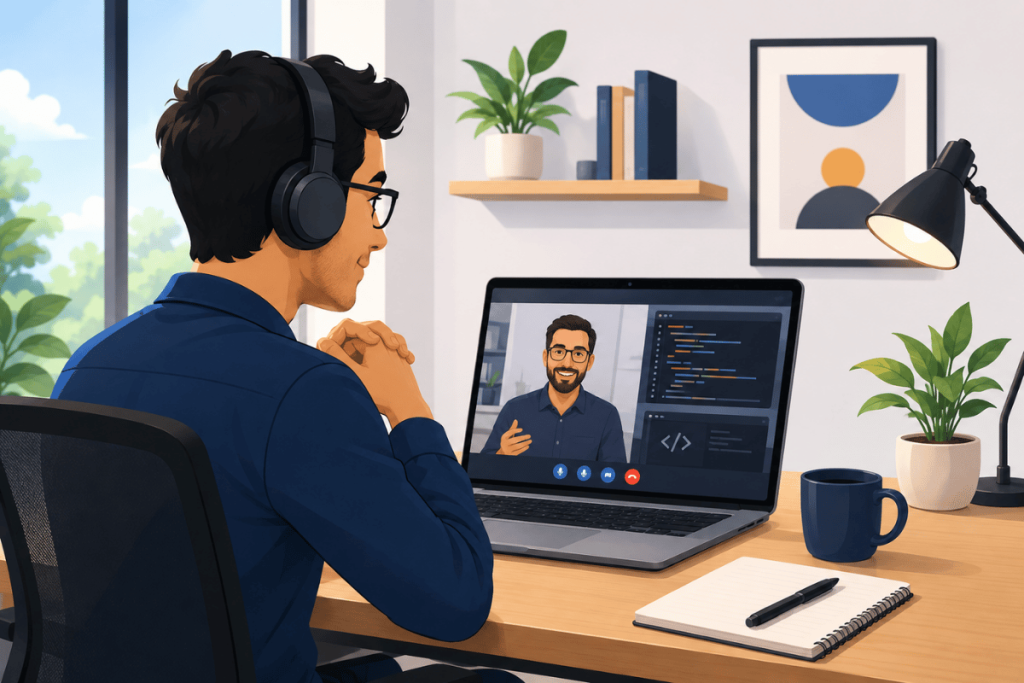

A remote developer interview tests more than whether you can write good code.
Employers also want to know how you solve problems, explain technical decisions, work independently, communicate when teammates are offline, and contribute to a distributed engineering team.
That is good news.
You do not need a perfect answer to every technical question. You need to show that you can think clearly, communicate confidently, and approach real development problems with sound judgment.
Whether you are interviewing for a full-time software engineering position, contract work, or project-based remote roles for developers, the following remote job interview tips can help you make a stronger impression.
1. Research the Company Before the Interview
Do not enter a developer interview knowing only the company name and job title.
Spend time understanding:
- What the company builds
- Who its customers are
- Which technologies it appears to use
- What the developer role involves
- Whether the team is fully remote or distributed
- What problems you may be expected to solve
Read the job description again before the interview and connect its requirements to your own experience.
If the company needs a React developer, for example, identify two or three React projects you can discuss confidently. If the role mentions APIs, AWS, Kubernetes, Python, Laravel, or another specific technology, prepare examples showing how you have used it.
The goal is not to memorize the company’s website. It is to make your answers relevant.
2. Prepare Your Developer Portfolio and GitHub
Your portfolio gives interviewers evidence beyond your résumé.
Before your interview, review your GitHub profile, portfolio website, LinkedIn profile, and any projects you included in your application.
Be ready to explain:
- What you built
- Why you chose the technology
- What you personally contributed
- What technical problem was difficult
- How you solved it
- What you would improve today
Remove broken demo links and make important repositories easy to understand.
A strong README, clear project description, sensible commit history, and working demo can strengthen your credibility before you even begin discussing the code.
Your online presence matters particularly when competing internationally. Building effective personal branding for remote careers can make your experience easier for employers to understand and trust.
3. Know Your Core Technical Skills
Remote interviews may include live coding, technical questions, system design discussions, debugging exercises, code reviews, or take-home assignments.
You cannot predict every question, so focus on fundamentals.
Review the concepts most relevant to your role, including your primary programming language, frameworks, databases, APIs, testing, Git, debugging, security basics, and software architecture.
Frontend developers may need to discuss JavaScript, browser behavior, performance, accessibility, React, Vue, or similar technologies.
Backend developers may be questioned about APIs, databases, authentication, caching, scalability, queues, or server architecture.
Full-stack developers should prepare for both.
Your preparation should also reflect current in-demand remote skills, rather than relying only on technologies you learned several years ago.
4. Practice Explaining How You Think
Getting the final answer is only part of a technical interview.
Interviewers often want to understand how you reached it.
When solving a coding problem, explain your reasoning:
- Clarify the requirements.
- State important assumptions.
- Describe your proposed approach.
- Write or discuss the solution.
- Test edge cases.
- Explain possible improvements or trade-offs.
If you get stuck, do not panic or become silent.
Explain what you know, identify what is uncertain, and work through the problem logically.
A developer who communicates clearly while solving a difficult problem can often make a stronger impression than someone who reaches an answer without explaining the reasoning behind it.
5. Prepare for Remote-Specific Interview Questions
A remote employer needs confidence that you can perform without constant supervision.
Expect questions such as:
How do you manage your time while working remotely?
What do you do when you are blocked and your manager is offline?
How do you communicate progress to a distributed team?
How do you work with teammates across different time zones?
How do you handle unclear requirements?
How do you stay productive without direct supervision?
Prepare real examples rather than generic statements.
Instead of saying, “I am a good communicator,” explain how you provided async updates, documented a technical decision, raised a blocker early, or coordinated a project across time zones.
Strong remote communication skills can be as important to distributed teams as being comfortable with the company’s technical stack.
6. Use Specific Examples in Behavioral Questions
Developer interviews are not only technical.
You may be asked:
Tell me about a difficult bug you solved.
Describe a disagreement with another developer.
Tell me about a deadline you struggled to meet.
Give an example of receiving critical feedback.
Describe a technical decision you would change today.
Structure answers around a clear sequence:
Situation → Responsibility → Action → Result
Keep most of your answer focused on what you did.
Avoid spending two minutes explaining the company or project before reaching your contribution.
Specific examples build more trust than statements such as “I work well under pressure” or “I am a team player.”
7. Show That You Can Work Independently
Remote developers frequently need to make progress when colleagues are unavailable.
Show that you know when to investigate independently and when to ask for help.
For example, explain how you would:
- Review documentation before escalating a problem
- Search existing issues or code
- Reproduce a bug before reporting it
- Document what you have already tried
- Ask a focused question instead of saying “it doesn’t work”
- Continue with another task when blocked
Independence does not mean avoiding communication.
It means making responsible progress while keeping the team informed.
Understanding how companies hire remote developers can also help you recognize why autonomy, communication, technical judgment, and reliability receive so much attention during remote hiring.
8. Prepare for Live Coding Without Trying to Memorize Everything
Trying to memorize hundreds of algorithm answers is rarely the best preparation.
Instead, practice solving unfamiliar problems.
During live coding:
Read the requirement carefully.
Ask questions if something is ambiguous.
Start with a reasonable solution before chasing the most optimized approach.
Use meaningful variable names.
Check your work.
Discuss complexity when relevant.
If the interviewer allows documentation, use it normally. Professional software development involves knowing how to find reliable information, not remembering every method or syntax detail from memory.
Most importantly, keep communicating.
Long silence makes it difficult for the interviewer to understand your thought process.
9. Treat Take-Home Assignments Like Real Work
A coding assignment is often an opportunity to show how you would actually contribute to the team.
Do more than make the code run.
Pay attention to:
- Code readability
- Project structure
- Error handling
- Testing
- Documentation
- Git usage
- Setup instructions
- Requirement coverage
Do not add unnecessary complexity just to appear advanced.
A straightforward solution you can defend confidently is often better than an overengineered architecture you cannot explain.
If the requirements are unclear, document your assumptions.
That itself demonstrates good remote working behavior.
10. Get Your Remote Interview Setup Ready
Your technology should support your interview rather than become a distraction.
Before the call, test your:
Internet connection: Make sure it is stable and have a backup option where practical.
Microphone: Confirm your voice is clear.
Camera: Position it at a comfortable eye level.
Lighting: Make sure your face is visible without strong light behind you.
Interview software: Open Zoom, Google Meet, Microsoft Teams, or the requested platform before the meeting.
Screen sharing: Practice switching between your browser, IDE, terminal, and meeting window.
Development environment: If coding is expected, ensure your editor, dependencies, Git, and terminal are ready.
Also close private messages, unrelated browser tabs, and notifications before sharing your screen.
Simple preparation helps you appear calm and professional.
11. Prepare Smart Questions for the Interviewer
A strong interview is a two-way evaluation.
Your questions can show that you are thinking about the work rather than only the salary or job title.
Ask questions such as:
What would success look like during the first three months?
How does the engineering team communicate asynchronously?
How are code reviews handled?
What is the biggest technical challenge the team is solving right now?
How much working-hour overlap does the team expect?
How are technical decisions documented?
What does the development and deployment process look like?
These questions also help you determine whether the opportunity fits the way you want to work.
12. End the Interview With Confidence
Do not let the interview simply fade out after the final question.
Thank the interviewer, confirm your interest if the role genuinely appeals to you, and ask about the next stage.
You can also briefly reinforce your fit:
“I enjoyed learning more about the role. The work around API development and distributed collaboration is closely aligned with my recent experience, and I would be excited to contribute.”
Keep it natural.
Confidence does not require overselling yourself.
It comes from clearly connecting your experience with the employer’s needs.
Common Mistakes Developers Should Avoid in Remote Interviews
Even technically strong candidates can weaken an otherwise good interview through avoidable mistakes.
Watch for these:
- Giving vague answers with no examples
- Speaking negatively about previous employers
- Claiming expertise you cannot demonstrate
- Starting coding before understanding the problem
- Staying silent while solving technical questions
- Ignoring remote communication questions
- Joining without testing your microphone or connection
- Reading obviously scripted answers
- Giving unnecessarily long responses
- Failing to ask the interviewer meaningful questions
If you do not know an answer, say so.
Then explain how you would approach finding the solution.
That is more credible than guessing.
What Makes a Developer Stand Out in a Remote Interview?
The strongest candidate is not always the person who knows the most technologies.
Employers need developers who can turn their knowledge into reliable work.
A compelling remote candidate can usually demonstrate four things:
Technical competence: You can handle the work required by the role.
Clear communication: You can explain ideas, blockers, decisions, and progress.
Ownership: You take responsibility for tasks and outcomes.
Remote readiness: You can remain productive and collaborative without relying on constant face-to-face interaction.
Show these qualities with evidence from real projects whenever possible.
Turn Strong Interview Preparation Into Real Opportunities
Interview preparation becomes much more valuable when you are consistently applying for roles that match your experience.
If you are actively searching, learn how Ojiiz connects professionals with verified remote opportunities. Understanding the process can help you move from searching for work to evaluating opportunities more efficiently.
When you are ready to take the next step, you can also explore verified remote jobs and projects on Ojiiz and look for opportunities that align with your development skills, experience, and career goals.
Prepare well, communicate clearly, and let your work prove what you can do.
Frequently Asked Questions About Remote Developer Interviews
How do I prepare for a remote developer interview?
Review the job description, research the company, refresh the technical skills required for the role, prepare examples from previous projects, practice explaining your problem-solving process, and test your video interview setup. You should also prepare for questions about remote communication, independence, time management, and collaboration.
What questions are asked in a remote developer interview?
Expect a combination of technical, behavioral, and remote-work questions. You may be asked to solve a coding problem, explain a previous project, discuss architecture choices, describe how you handle blockers, or explain how you communicate with distributed teammates.
How can I pass a remote technical interview?
Focus on understanding the problem before coding. Ask clarifying questions, explain your reasoning, create a workable solution, test it, and discuss trade-offs. Interviewers are often assessing your problem-solving process as well as the final answer.
What should I say when I do not know an answer in a developer interview?
Be direct. Say that you have not worked with that specific concept or are unsure of the exact answer, then explain what you do know and how you would investigate it. A thoughtful approach is stronger than pretending to know something you do not.
What questions should developers ask during a remote job interview?
Ask about team communication, working-hour overlap, code review, engineering challenges, development processes, onboarding, performance expectations, and how the company measures success in the role. These questions help you understand both the technical environment and the remote working culture.
How do I stand out in a remote software developer interview?
Use specific examples. Show evidence of technical ability, communicate your thought process clearly, demonstrate ownership of previous work, and explain how you succeed in distributed environments. A strong portfolio and well-maintained GitHub profile can further support your claims.
Should I use notes during a remote interview?
Brief notes can be useful for remembering questions, project details, or important points you want to discuss, provided the interview format permits them. Avoid reading prepared answers word for word. Your responses should sound natural and respond directly to the interviewer.
What should I wear for a remote developer interview?
Choose clean, professional clothing appropriate for the company’s culture. Developer teams may dress casually, but appearing prepared and presentable helps create a professional first impression on video.