






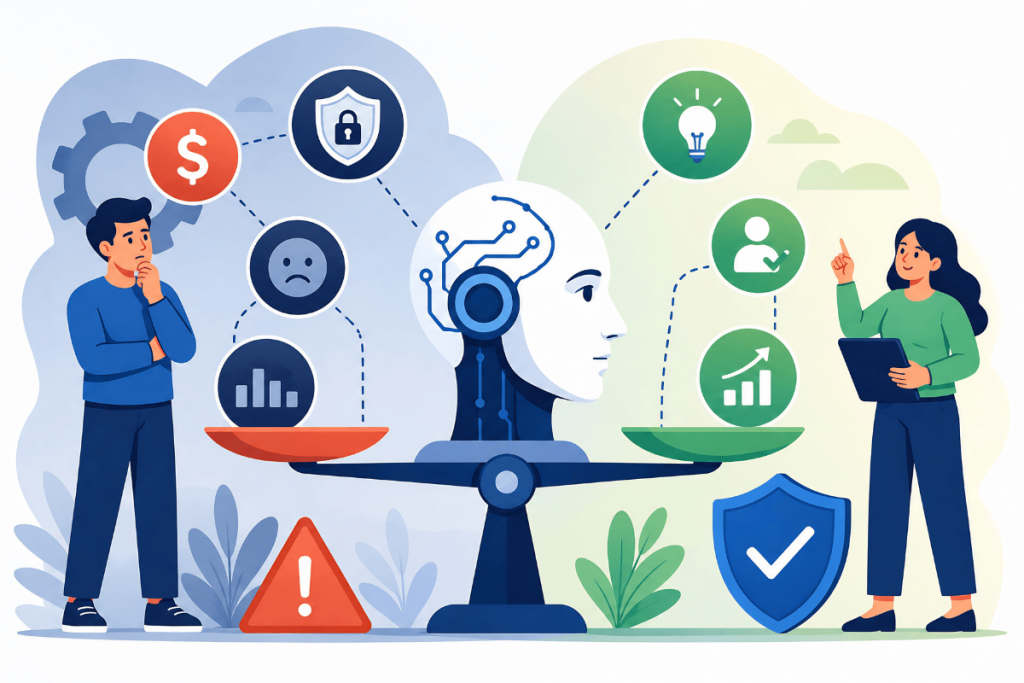

Artificial Intelligence (AI) is transforming modern businesses at an incredible pace. Companies now use AI for lead generation, customer support, marketing automation, analytics, cybersecurity, and workflow optimization. From startups to global enterprises, organizations are investing heavily in AI technologies to improve efficiency and gain a competitive advantage.
However, AI adoption is not always simple.
While AI offers significant benefits, businesses also face serious challenges during implementation and long-term usage. High costs, data privacy concerns, skill shortages, and integration problems can slow progress and create operational risks.
This guide explores the biggest challenges of AI in business, why these issues matter, and practical solutions companies can use to overcome them.
What Are the Main Challenges of AI in Business?
AI implementation involves more than just purchasing software. Businesses must manage infrastructure, data quality, employee training, and ongoing optimization.
The most common AI business challenges include:
- High implementation costs
- Data security concerns
- Lack of skilled professionals
- Poor data quality
- Ethical and bias issues
- Over-reliance on automation
Understanding these challenges helps businesses build more realistic and sustainable AI strategies.
High Implementation Costs
One of the biggest barriers to AI adoption is cost.
AI systems often require:
- Advanced software
- Cloud infrastructure
- Security systems
- Ongoing maintenance
For startups and small businesses, these costs can become overwhelming, especially when exploring how startups hire remotely using AI and manage growing operational demands.
Additional Expenses Include:
- Employee training
- AI consulting services
- Data management systems
- Workflow integration
Many businesses underestimate the long-term investment needed to maintain effective AI systems.
Data Privacy and Security Concerns
AI relies heavily on data.
Businesses often collect:
- Customer information
- Behavioral data
- Financial records
- Business analytics
If not managed securely, this data can become vulnerable to breaches and cyberattacks.
Common Security Risks
| Risk Area | Business Impact |
| Data Breaches | Loss of customer trust |
| Weak Security Systems | Increased cyberattack risks |
| Compliance Violations | Legal and financial penalties |
| Unsecured AI Platforms | Exposure of sensitive business data |
Businesses must prioritize cybersecurity and compliance when implementing AI systems.
Lack of Skilled AI Talent
AI expertise remains in high demand globally.
Many businesses struggle to find professionals skilled in:
- Machine learning
- Data analysis
- AI automation
- AI system management
This talent shortage slows AI adoption and increases hiring costs.
Why This Matters
Without proper expertise:
- AI systems may perform poorly
- Businesses may misuse AI tools
- Productivity improvements may not materialize
Training existing employees is often necessary for long-term success.
Poor Data Quality
AI systems depend on high-quality data to make accurate decisions.
Incomplete or inaccurate data can lead to:
- Poor predictions
- Incorrect automation
- Biased recommendations
Even advanced AI tools cannot perform effectively with weak data sources.
Best Practices for Better Data
- Organize data consistently
- Remove duplicate information
- Update outdated records regularly
- Monitor data accuracy continuously
Clean data improves AI performance significantly.
Integration with Existing Systems
Many businesses already use multiple software platforms.
Integrating AI into:
- CRM systems
- Marketing tools
- Workflow platforms
- Customer support systems
It can become technically challenging.
Common Integration Problems
- Compatibility issues
- Workflow disruptions
- Slow system performance
- Increased operational complexity
Businesses should choose scalable AI tools that integrate smoothly with existing systems.
Ethical and Bias Concerns
AI systems are only as unbiased as the data used to train them.
Poorly trained AI can create:
- Discriminatory decisions
- Biased recommendations
- Unfair customer experiences
This creates ethical concerns and damages business credibility.
Why Ethical AI Matters
Responsible AI usage helps businesses:
- Build customer trust
- Maintain transparency
- Reduce legal risks
- Improve decision-making fairness
Businesses should regularly review AI systems for bias and fairness.
Over-Reliance on Automation
Automation improves efficiency, but relying too heavily on AI can reduce the human element in business interactions.
Over-automation may lead to:
- Generic communication
- Poor customer experiences
- Reduced creativity
- Lack of emotional understanding
AI should support human decision-making, not replace it entirely.
Common AI Challenges by Business Size
Small Businesses
- Budget limitations
- Limited technical expertise
- Difficulty scaling AI tools
Mid-Sized Businesses
- Integration challenges
- Data management complexity
- Balancing automation with personalization
Large Enterprises
- Large-scale infrastructure costs
- Compliance and governance issues
- Managing multiple AI systems
Each business size faces unique AI adoption challenges.
How Businesses Can Overcome AI Challenges
1. Start Small
Businesses should begin with small AI implementations before scaling.
Examples include:
- Chatbots
- Email automation
- AI analytics tools
Small projects reduce risk and help teams learn gradually.
2. Invest in Employee Training
Employee education is essential for successful AI adoption.
Training should focus on:
- AI tool usage
- Data management
- Security best practices
- Ethical AI awareness
Skilled employees improve AI efficiency and reduce operational problems.
3. Improve Data Quality
Strong data management improves AI performance significantly.
Businesses should:
- Audit data regularly
- Remove inaccurate records
- Standardize information collection
Better data leads to better AI outcomes.
4. Choose the Right AI Platforms
Not every AI platform fits every business.
Businesses should prioritize platforms that offer:
- Scalability
- Security
- Ease of integration
- Reliable support
Choosing the right platform reduces long-term operational issues.
The Role of AI Governance in Business
AI governance refers to policies and frameworks that ensure responsible AI usage.
Strong governance helps businesses:
- Maintain transparency
- Reduce risks
- Improve compliance
- Monitor AI performance
AI governance is becoming increasingly important as businesses expand automation.
How Platforms Simplify AI Workflows
Managing AI systems across multiple workflows can become complex without the right infrastructure. Modern business platforms help simplify operations by centralizing communication, workflow management, and lead tracking.
Platforms like Ojiiz help businesses streamline operations, manage opportunities, and organize workflows more efficiently in AI-driven environments. Reducing manual tasks and improving workflow visibility, it allows businesses to focus more on strategy, growth, and customer relationships.
Future Challenges of AI in Business
As AI continues evolving, businesses will face new challenges.
Future concerns may include:
- AI regulation and compliance
- Advanced cybersecurity threats
- Workforce displacement concerns
- Ethical AI governance
Companies that prepare early will adapt more effectively to changing AI landscapes.
AI Adoption Checklist for Businesses
Before implementing AI, businesses should evaluate:
- Business goals
- Budget availability
- Data quality
- Security infrastructure
- Employee readiness
- Scalability needs
A strategic approach reduces risks and improves long-term AI success.
Conclusion
AI offers enormous opportunities for businesses, but successful adoption requires careful planning and realistic expectations. High costs, security concerns, poor data quality, and integration challenges can create significant obstacles if not addressed properly.
Businesses that focus on responsible AI implementation, employee training, strong security practices, and scalable systems will gain the most value from AI technologies.
Rather than replacing human expertise, AI should enhance productivity, improve decision-making, and support long-term business growth. The companies that balance automation with strategy and human oversight will lead the future of AI-driven business innovation.
Frequently Asked Questions (FAQs)
1. What is the biggest challenge of AI in business?
The biggest challenge is often balancing implementation costs, data quality, and integration complexity while maintaining security and efficiency.
2. Why do businesses struggle with AI adoption?
Many businesses face difficulties due to limited budgets, a lack of skilled professionals, and poor data management systems.
3. Can small businesses use AI successfully?
Yes, small businesses can benefit from AI by starting with affordable tools and scaling gradually over time.
4. How does poor data affect AI systems?
Poor-quality data leads to inaccurate predictions, biased automation, and inefficient AI performance.
5. Is AI a security risk for businesses?
AI can create security risks if businesses fail to protect sensitive data and maintain proper cybersecurity practices.
6. How does Ojiiz support AI-driven business workflows?
Ojiiz helps businesses streamline workflows, manage opportunities, and improve operational efficiency in AI-supported business environments.
7. Is Ojiiz suitable for growing businesses using AI tools?
Yes, Ojiiz supports growing businesses by simplifying workflow organization and reducing manual operational complexity.
8. What is the future of AI in business?
AI will continue expanding across industries, with increased automation, smarter analytics, and stronger integration into daily business operations.